Tour of Utah Recap – Stages 4-6

Back to the story…  

Stage 4 – Lehi to Salt Lake City (134.3 miles)

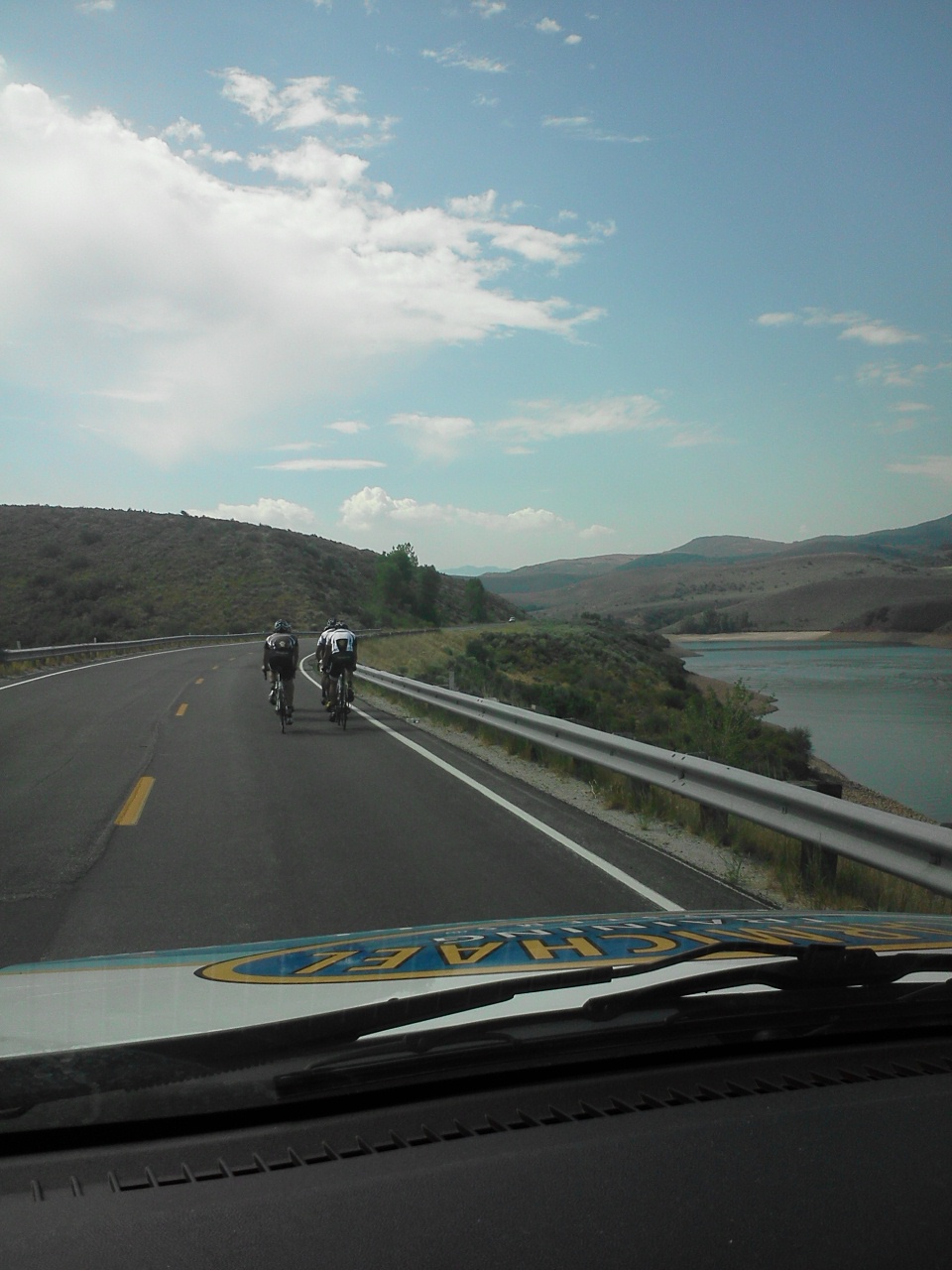
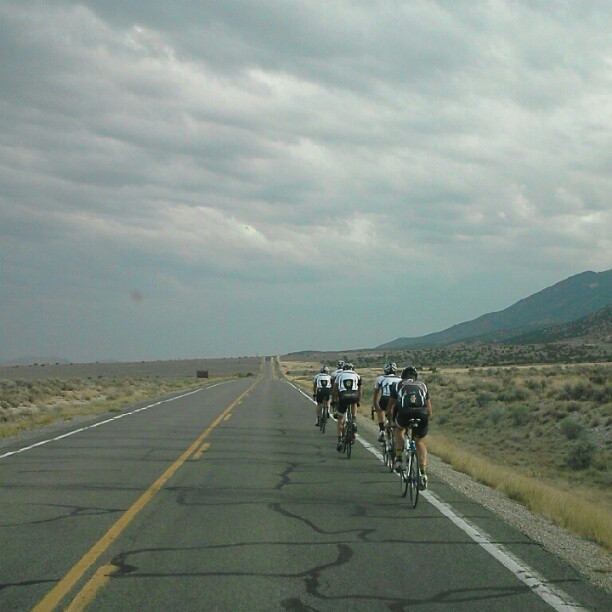
We started about 25 miles into Stage 4.  Because it was a 134 mile stage, and it had a “lollipop” in it, we had to push forward to get as far into the stage as we could before getting held up by the pros coming through.  Our start point was in the middle of the Utah desert.  Seriously… it was the desert.  The stage profile was very flat, so the riders made pretty good time.  Unfortunately, because it was the desert, there was very little scenery.  I did snap a few shots of the flat landscape and some Pony Express landmarks, though.

We did get caught by the pros on the lollipop, but we made it almost to the “end of the stick” before heading north, towards Salt Lake City.  It was a very long day, and I blame it mostly on the lack of scenery for the first several hours of the ride.  The week, so far, had been uneventful, as far as mechanical or rider support issues, which was good.

Stage 5 – Newpark Town Center to Snowbird (101.1 miles)

This stage was the queen stage of the Tour of Utah, with around 10,000 feet of climbing.  There were some serious climbs ahead of the guys, but we were more concerned about the start of the ride.  We were scheduled to have a ceremonial start at Newpark Town Center in the midst of a gran fondo that rode the entire race course.  Instead of the “ceremonial start” we were supposed to get, we ended up getting thrown in amongst the fondo riders.  In case you weren’t aware of it, support for an event like ours gets a lot harder when you add an extra 700 RIDERS to the road…

The extra riders added to the confusion, for sure.  At our first rest stop, I tried to speed up to get going and beat a group of fondo riders back onto the road, and forgot to shut the tailgate of the truck.  Looking in the rear-view mirror, I saw my big cooler come out of the truck and go spinning into the highway, rocketing bottles all over the place…  I cleaned up the mess, drove to a grocery store to replenish my ice and water, and continued on.  Everything was good in the end, but for about 45 minutes, I was pretty panic-stricken.

As we continued on, I had to fight my way through the fondo traffic up and down the intermediate KOM climbs to keep up with my group.  The climbs were tight and twisty, and it was very difficult with two-way bike traffic and auto traffic.  We managed to make it through the KOM’s, through the small towns where sprints were located, then approached the climb to Snowbird.  I had visited Snowbird before for a Specialized dealer event, about 3 years ago, so I knew the climb up to the resort.  It was a long, somewhat steep climb, and coming at the end of a 100-mile day, it was going to be no easy feat for our guys.

I made the decision to give the guys bottle hand-ups from the roadside on the way up the hill.  They would ditch their empty bottles, I’d give them a fresh bottle, then I’d give them a spray of water on their back or head and give them a push up the road.  This made a huge difference to them.  They were able to shed a bottle, get a little reprieve from the heat, and get a friendly boost up the road.  Helped for a second, at least…

All the guys made it up the climb, except one coach, Colin Izzard.  He had the legs to go up the climb, but one of the riders suffered a broken spoke, so he sacrificed his rear wheel and helped me sag the guys up the hill.  I definitely needed the help that day.  It was hot, and we did a lot of work on that last climb, making sure all the guys were okay.

Stage 6 – Park City to Park City (77 miles)

This was the final day of the Tour of Utah, and had some of the steepest climbing I had ever seen.  The ride was pretty chill for a long while, except for scrambling around for some odd course markings on some smaller, sketchier roads.  A lot of times, we headed out earlier than the course marking crews, so sometimes we miss turns if the numbers in the race bible get jumbled.  We had two or three odd turns that weren’t marked well, so we had to figure that out before moving forward.  Once we got back on the main road, we found our way.

There were a few major climbs in this stage.  The first was through a gated neighborhood, Wolf Creek Ranch, usually closed to the public.  Once we turned on the climb, we one of the steepest pitches I had ever seen.  After 5 days of riding, I know the guys were begging for it to stop, but the climbing continued…  The boys started “paperboy-ing” (weaving side to side to take the edge off the climb), so I got out of the truck to give them little pushes through some of the turns.  Unfortunately, this was only the first major climb of the day…

The guys continued on, rolling comfortably until we approached Empire Pass.  Empire Pass was hand-selected by Levi Leipheimer for this race, due to it’s length and difficulty, and probably because Levi knew the climb inside and out (Levi won Stage 6 on this day, after our athletes finished).  Needless to say, this climb was a huge obstacle for the athletes, regardless of their fitness.  Less than 500 meters into the climb, the “paperboy-ing” started again…  I knew we were in for it.

Strangely, one of our athletes, Shannon Lawrence from Bermuda, started stretching his legs a bit.  He was very nervous going into the day, and said for the first 40 miles of the ride that his legs were feeling very heavy.  On Empire Pass, he had evidently worked all the kinks out, because he steadily motored away from the rest of the group.  I don’t know what got into him, but he changed from flatlander to climbing machine that day.  It made things a bit difficult for me, though… he was so far up the road, I would have to zoom ahead in the truck to take care of him, then wait or drive back down the mountain to feed and push the other riders.  It was definitely a test of my abilities, not as a mechanic, but as a sag driver (NOTE:  My legs were sore the next day from running and pushing riders up 20% grade hills for two days… just sayin’…).

Shannon made it to the top first, and the rest of the group followed shortly thereafter.  There was a nice, long, windy descent with one minor little kick in it before the finish in Park City.  All the group descended into town together and finished the CTS Tour of Utah Race Experience together.  All the guys made it, and like most of the CTS events I’ve been to, they seem to have forged a bond and developed a sense of team accomplishment that I have only seen in my days in the Marines.  All the guys are friends, and seem to have gained a brotherly bond over the course of the week.

After we returned back down to Salt Lake City, I began packing bikes for the riders’ journeys home.  Once completed, we organized the trucks to travel to their respective destinations, then got ready for our team dinner and departure.  Another race week in the books.  Next up, four days off, then back out west for the Tour of Colorado… STAY TUNED!
Tour of Utah Recap – Stages 1-3

My week at the Tour of Utah with Carmichael Training Systems was amazing, as expected.  We had four athletes and three coaches, so the workload was okay for just one mechanic (me) and one soigneur (Colleen).   Here’s a quick little day by day rundown of what happened:

Pre-Race Organization Day

The day before the start of the race, all the athletes and staff arrived, and we hit the ground running.  As the athletes each arrived from the airport, they brought their bikes to me in the hotel parking lot, where all the teams were set up.  I found a great spot next to some mechanic friends that work for Optum/KBS and got comfortable.  My workspace consisted of a folding table, my toolbox, a box of ProGold lubricants and supplies that we were given (Thanks, Bruce!), my Feedback Sports Pro-Elite repair stand, two a-frame bike racks, and a CTS E-Z Up tent.  That was really all I needed to get bikes built.  Later in the week, I would need water hookups to wash down the bikes and such, but for initial building and preparation, it wasn’t necessary.

After all the prep work was done for the first stage, we had a rider/staff meeting to introduce each other, discuss the details of the camp, and plan out the next day’s schedule.  It’s important to keep meetings like that kind of chill and to try and get to know the athletes a little better.  Developing trust with them is key.  They need to trust me to work on their bikes and support them throughout the week.  I try to learn the athletes’ little habits and nuances early in the game, so I can address them before a situation arises on the road.  By doing that, we can eliminate a lot of panic-stricken situations in the future.

Stage 1 – Ogden to Ogden (131.7 miles)

The logistics of this first day were kind of weird.  In order for us not to get caught by the pros, we had to cut off a little “lollipop” section of course near Henefer, UT.  We started out strong for about 200m… then the day’s first flat tire.  Because we hastily prepared and had supplies and staff coming from several different locations, we forgot to pack any spare wheels.  After installing a new tire and tube, the new tube was pinched by the tight bead of the tire.  Flat tire number two.  After changing that, we were on our way.

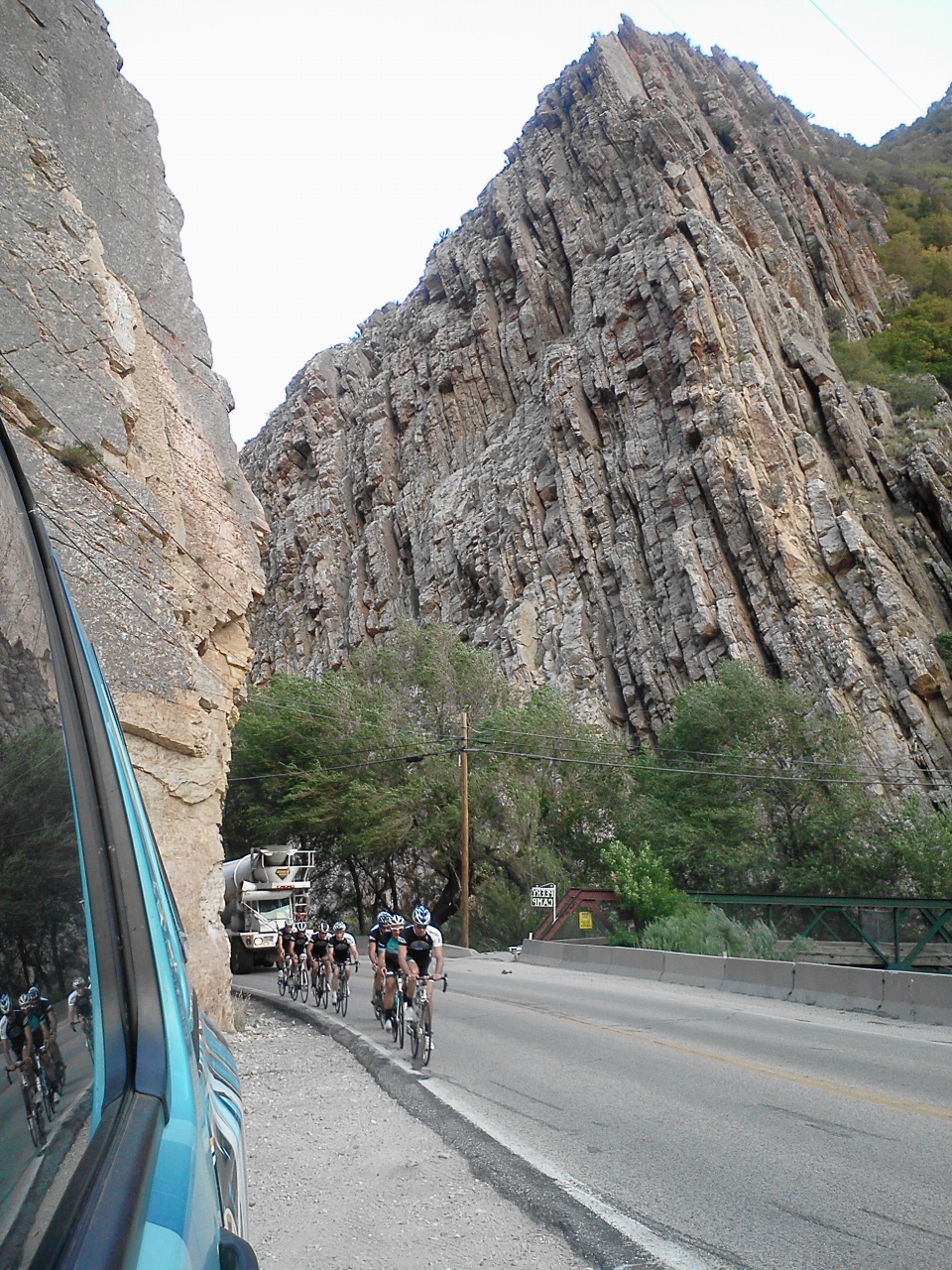
Less than 30 minutes later, as the riders were ascending through a tight canyon, just north of Ogden, we had a third flat on the road.  One rider picked up a piece of debris in a tire, causing him to develop a somewhat slow leak.  The object was removed from the tire, a new tube installed, and we were back on the road… again.  Luckily, this would be the last flat for quite some time.  We continued out of the canyon, and kept pedaling down the road.

After several rest stops and our turn around point on Hwy 65, we returned towards Ogden.  We had to stop near Interstate 84 and wait a few minutes because the pro race was coming through.  It gave us a good time to refuel, and the first chance for the CTS athletes to see the actual race in progress.  Afterwards, we continued back up towards Ogden, making a rest stop in Eden.  At the Eden rest stop, CTS coach Kirk Nordgren’s cousin was waiting with her kids and had homemade signs to cheer him on!  That was a really cool experience, primarily because it was in the middle of nowhere, and they were just hanging out waiting for us.

After the last KOM of the day, North Ogden Divide, CTS coach Colin Izzard’s carbon clincher wheels came apart on the descent.  He had been feeling pulsating during braking all day, but we couldn’t feel anything structurally upon inspection.  Less than 500m into the descent, he comes on the radio and said his wheels were toast.  Both his tires had punctured, and both his rims were victims of overheating and delamination.  Not cool.  He was very lucky to be able to control the bike without crashing, or worse.  Definitely a situation where spare wheels would have been nice to have.  We loaded he and his bike in the CTS truck and continued down the hill to finish with the group.

I had a bit of parts-switching to do after Stage 1.  Kirk (camp manager), offered his wheels to Colin (lead coach), so he could continue to ride with the CTS athletes.  Going from carbon rims to aluminum rims, this meant switching brake pads, wheels, and ensuring the gearing was proper for the rest of the week’s climbs.  After switching around the parts, the bikes were washed and tuned, before stowing them in my hotel room (because of lack of a team trailer at this event – the CTS trailer was at Leadville, CO, supporting the riders at the Leadville Trail 100).

Stage 2 – Miller Motorsports Park – Team Time Trial (13.5 miles, 3 laps)

We transferred from our hotel in Ogden, south of Salt Lake City to Miller Motorsports Park, near Tooele, UT.  The CTS athletes were getting the opportunity to get on course before the pros for the Team Time Trial stage of the Tour of Utah, which meant they were going to be riding their bikes on the world-class track, normally used for motorcycle and auto racing.  We were able to set up our pit area inside one of the garages at the facility, just like the pro teams did.  The guys took three laps on the track; one to warm up and get used to the track, a second “hot” lap, where they utilized time trial tactics, and after a quick clinic on the team time trial, a third cool-down lap.  The guys were stoked to be able to get on the course, and I was stoked to be able to follow them in the support vehicle.  I’m not going to lie… it was pretty rad to drive the truck on the track, even if I wasn’t pushing it as hard as I would have liked…

I left the track a little earlier than the athletes, so I could get back to the hotel and get the bikes ready for the next day’s stage.  The guys only did 13.5 miles on the day, so they didn’t need as much attention as they did after a 100-mile day.  I wiped them down with some ProGold ProTowels, checked them over, and put the bikes away for the evening.

Stage 3 – Ogden to Salt Lake City – 85.5 miles

Stage 3 was very interesting.  The Tour of Utah’s route utilized a lot of the same roads on this stage as it used on Stage 1, just backwards.  The first climb of the day was heading the opposite direction over North Ogden Divide, then ran the route backwards, to Snowbasin for the third time this tour.  Following that, we descended down to Morgan, UT, and around a reservoir to Hwy 65, and up over a mean little climb called Big Mountain.  It was a pretty big challenge for the guys, and there was some separation in the group, but the view at the top and the descent into Salt Lake City was amazing.  The CTS athletes continued to surprise me, and did a great job staying together.  It made it pretty easy to support them from the vehicle, and take care of them when they needed assistance because of their cohesion as a group.

Except for Stage 1, there were no real mechanicals, flats, or any real issues up to this point, which made me feel pretty confident in the work I was putting into the bikes.  Usually, the third day is when everything starts to get ironed out, as far as systems go.  I was starting to nail down my organization of the support vehicle, seeing how things were working for me on a couple of road race stages, and figuring out the group’s dynamic.  After a few days on the road, you get used to their patterns of natural breaks and rest stops, and beat them to the punch. The key is to be one step ahead of the game, unless you can’t be… then you just remain flexible.

I’ll write more about stages 4-6 tomorrow.

Tour of Utah, Here We Come!!!


Tour of Utah
Right now, I’m on a plane from Phoenix to Salt Lake City, mentally getting ready to work at the 2012 Tour of Utah, once again with Carmichael Training Systems. To the everyday mechanic or bike nut, it may not seem like a lot of preparation would be necessary, but a lot of logistics are involved in an event like this for a freelance race mechanic, like myself.

First, the bikes. Over the course of the week, I’ll work on some really high-quality racing bikes, just like team mechanics do. Unfortunately, I’m at a bit of a disadvantage, because all the equipment I work on is different. Each rider has different wheels, pedals, drivetrain, power meter, shoes, etc. No one bike is the same, and as their mechanic for the week, I have to know the in’s & out’s of every component of every bike. This also requires that, in some cases, I have special component-specific tools on hand, which means I have to know what I’m working with a few weeks ahead of time. CTS is good about getting a list of clients’ equipment, so I can be prepared.

In the event there is something I run into that I need to have to return a bike to proper working order, I may have to make a bike shop run. Before the event, I usually find the two closest, high end bike shops to the race hotel and record their contact info, so I don’t have to chase it down if I’m crunched for time.

Second… travel. Where most team mechanics have a truck and trailer, loaded with the things they need for the Tour, I’ve got to travel with my gear. Because of airline restrictions, there are weight and size limits to what you can bring on airplanes, without getting charged ungodly baggage fees. I have to take my own personal luggage, my tools, and my repair stand. I keep my toolbox around 45-50 pounds, which means my essential tool choices are critical. Today, I got lucky and avoided a $125 fee by gate-checking my repair stand, which I’ve never done before. Luckily, for me, the Feedback Sports Pro-Elite repair stand looks a bit like a camera tripod, which saved me some flack from TSA.

Lastly, finding the prime parking spot.  There are always really great spots around the hotels for team trucks and trailers.  The best spots have very close water and electrical hookups, and since I don’t have a trailer, and most of the bigger teams have beaten me to the hotel by a day and a half, most of the spots are taken.  I’ve been networking my way around the hotel to see if I can sneak in and borrow some water and power when they’re not busy this week.

It’s good to have connections, and to make friends in this industry.  The professional race mechanic arena is very small.  These guys are highly skilled, overworked, caffeine-fueled road warriors… and are all really good folks.  You’ve got to make friends, because if you do somebody wrong, it’ll come back to bite you, for sure.  I’ll get everything figured out.  Adapt and overcome, as we used to say in the Marines… but it definitely helps to have folks that will help you out in a pinch.

More photos and updates to come as the week progresses.  Tomorrow, bike builds and race preparations are on the schedule.  Adios!

Repair Stand Roulette

After working USPRO Championships with Team Exergy in May, I sold my trusty Park Tool PRS-21 repair stand to a buddy back home, so I could purchase a new stand I had seen on some cycling blogs, the Feedback Sports Sprint repair stand.  The SRAM NRS West Coast crew and Josh from Team Exergy had already been using  the Sprint stand since Sea Otter, and being a fan of the fork-mounted repair stand, I wanted to get my hands on one.  I called Feedback, and placed one on backorder to ensure delivery as quickly as possible.

Fast forward a few months… no Sprint Stand yet.  I called back and forth to Feedback to see if there were any updates, and they told me that they had received some feedback (pardon the pun) on the stands from the prototype units that had been sent to the race teams, and were making improvements before they put them to market.  I completely understand that, and as an end-user, I’d rather not hassle with additional modifications needing to be made after the initial purchase.  It should be as simple as pulling the stand out of the box and getting to work.

Unfortunately, the delivery date on the Sprint stand is August 9th-10th, and I’m flying out for the Tour of Utah on the 5th of August, so… I had to make a switch.  This time around, I had to pass on the Sprint stand for the good ol’ Feedback Pro-Elite stand.  I’ve used the Pro-Elite in the past at several events, and used the same clamp in a Park floor-mounted shop stand before.  It works well, and I’ve had no issues with the ones I’ve dealt with on previous occasions, so I don’t mind making the switch.  It will be here next week, just in time for the Utah trip.

Thanks to Feedback Sports for not compromising the integrity of the product by pushing it to market before it is ready, and ultimately looking after the customer.  Even though the outcome isn’t exactly what I had hoped for, I appreciate the honesty and the willingness to work with me to get me taken care of in a pinch.  I look forward to dealing with Feedback Sports again in the future, because of their great products, but more importantly, because of their amazing customer service.

(Another quick customer service note about Feedback Sports:  Earlier this year, at the CTS Bucket List Tour of California Race Experience, we didn’t have any racks to hang the bikes from before or after rides, and were in a bind.  We had been leaning the bikes against the truck and trailer for the first two days of the event, which was not very safe, especially with the quality of the bikes that the CTS clients were riding.  One of our mechanics, Mike Hetrick (Mr. Goodbike, Gainesville, FL) called his friend Doug (founder/president of Feedback) and he was able to ship us two A-Frame portable event stands NEXT DAY from Colorado, allowing us to be safe with the bikes, and to be more efficient in our work for the remainder of the trip.  This is one reason I decided to choose Feedback Sports for my repair stand purchase.  Kudos to the staff of Feedback Sports for all their good work!)

Rapha Rising – Circle of Death Challenge

Rapha Rising - The Circle of Death

I don’t think I’ve mentioned it before on this blog, but I’m addicted to Strava.  For those of you unfamiliar with Strava, it’s a cycling/running program that you track ride/run statistics with, and you can use it to compare stats and compete with friends.  You may have seen the television commercials on during the Tour de France coverage, featuring Tim Johnson (Cyclocross stud, multi-time National Champ, and one of my former riders on the Jittery Joe’s Team when I wrenched for them), Jesse Anthony (Optum p/b KBS rider), and others.

The cool thing about Strava is that you can set particular segments of road or trail, and the program keeps track of your times via your mobile phone or GPS-based computer.  I find it extremely fun to challenge myself on particular segments (mostly uphill), and see how this 200+ pounder compares to his 170 pound counterparts.  I’ve pushed myself harder to compete on climbs, even though I’m not a natural climber, and it’s been a good training tool for me, since I’ve started riding seriously again.

Last month, Rapha posted a challenge to Strava users that was to take place last week called the “Rapha Rising Challenge.”  The challenge was to climb 6,881 meters (22,575 feet) over the course of last week, which was equivalent to the “queen stage” of the Tour de France, which took place last Wednesday.  Basically, you had to climb, in one week, the same amount the pros did in one day…

I wasn’t planning on completing the challenge, but I got a good start, getting several thousand feet of climbing in on Monday of last week.  On Tuesday, I pounded out a big ride with the Free-Flite Canton group ride, where I pulled a lot, we broke some records (collectively), and after splitting from the group, I tacked on a few more miles.  Wednesday and Thursday, I figured I’d add a couple of extra rides and see how my climbing was adding up.  We took off for the beach this weekend, so I got a long climbing ride in on Friday morning (3 hours, 3700 feet of climbing) before we took off for Myrtle Beach, SC.

Myrtle Beach is obviously flat, which was not conducive to setting any climbing records.  I was going to do laps in the parking garage to get a little bit of climbing, but I didn’t have any expectations of getting the remainder of my climbing – around 4400 feet) finished by Sunday at Midnight, so I just canned that idea.  We enjoyed our time at the beach and headed home on Sunday.

We rolled into my parents’ house for the night around 6:30pm on Sunday.  I talked my wife into letting me ride some more and see how much climbing I could finish before it got too dark.  I rode about 3/4 mile down the road to Old Six Mile Road, where I did repeats until 9pm.  I rode to my parents’ house and had close to 1200 feet of climbing left to go… only 3 more repeats.

After much sweet-talking and a few bottles of Gatorade, I headed back down the road with Niki in the van behind me, shining headlights so I could see where I was going.  Together, we knocked out three more hill repeats, and finished up with 56.3 miles and 4236 feet of climbing for the evening, all on Old Six Mile Road… and I was cooked.  We got home and I uploaded the data to Strava, and… I was around 15o FEET SHORT!  99% complete with the challenge was not going to cut it…

Since it was only 10:45pm at that point, I jammed my bike back in the van and drove down to Clemson.  It’s a pretty well-lit town, so I felt comfortable riding downtown and around the university for a few miles to tack on the extra few feet I needed to finish the challenge.  I completed an extra 3.8 miles and 259 feet of climbing, and FINALLY finished the challenge with 6,917 meters of climbing for the week.

I had to take a day off after completing the challenge, especially after the strong finish on Sunday.  Would I do the challenge again?  Absolutely, except next time, I won’t plan a beach trip in the middle of it, so I can space out the climbing better.  I think because of the climbing that I had to seek out to complete the challenge, I’m actually enjoying climbing a little more.  I’ve kind of honed some of my techniques and I now look forward to the hills a little more.