Passing It On

Over the course of the last few weeks, I’ve had the pleasure of interacting with several mechanics, some who are aspiring to either jump into the race mechanic scene, and others who plan on opening their own shops in the near future.  We have had discussions about goals, dreams, plans, ideas, and aspirations for the future, as well as how I got started in the industry, as a race mechanic, and how I landed where I am right now.

I consider it a privilege and honor to talk to these up-and-comers, and appreciate the fact that they value my opinion as someone who has gone before them in the bicycle mechanic arena.  I don’t consider it a burden to pass on information or spend time with any of these guys and gals, because I was there once, myself.  If there hadn’t been other mechanics who had followed the same path and passed the knowledge and experience on to me, I wouldn’t be doing what I’m doing now.  I can’t name them all, but a few of the influential mechanics and bike folks in my life are:

  • John Duncan – John was the owner of the first bike shop I worked at, WheelSport Bicycles in Anderson, SC.  After begging for a job for a long time, John finally gave me a shot.  I had already been working on my own bikes for a few years, but he gave me the entrance into the industry that I had been longing for.  John schooled me on repairs, especially fine-tuning derailleurs.  One of the tidbits of advice that John told me, that sticks with me is, “Tune every bike like MY kids are going to be riding them.”
  • Merlyn Townley – As the back of his business card says, Merlyn “gets things done.”  One of the most experienced mechanics I’ve ever met, Merlyn has been around the world and back, wrenching on bikes all along the way.  Merlyn was one of my instructors at the Bill Woodul Mechanics’ Clinic in 2005.  He instructed classes on cyclocross race support and wheel changes.  His tips and advice in that clinic stayed with me, especially his compliments on my attempts at pushing riders back into a race.  I pride myself in a good push… and Merlyn taught me that.  He is one of only a handful of Category 1 mechanics in the United States, something I still aspire to be.  We’ve become friends over the years, and chat often regarding work we’re doing.  Good to have him on my side.  Visit Merlyn’s business here.
  • TJ Grove – TJ is a rock-star mechanic, and also one of my former instructors at the USAC Mechanic’s Clinic.  His resume is a mile long, including work at several Olympics, World Championships, and multiple WorldTour teams, just to scratch the surface.  It’s always good to see him at the races, because of his amazing demeanor, even under pressure.  He’s one of the hardest working mechanics in the business, and I observe him in action, every chance I get, in order to soak up a new tip, trick, or shortcut that I can use in my own work.
  • Calvin Jones – Anyone who has used a blue, Park tool in the past 20 years, can most likely thank Calvin for the development of it.  Calvin is the head mechanic/tool guru at Park Tool, and also an instructor at the Bill Woodul Clinic.  He’s a very likable character, and has an encyclopedic knowledge of everything that has to do with bicycles.  To obtain some of Calvin’s knowledge for yourself, visit his blog.

Like I said, these are just a few of the great mechanics that have helped me along in my career.  They’ve given a little bit of themselves and their vast knowledge and experience to mechanics who want to follow in their footsteps.  Now that I’ve got over a dozen years in the industry, including several years as a race mechanic, I feel indebted to these men, and many others, for their help along the way.  It’s my pleasure to offer advice, help, or any input to those who are looking to get a start in the business.

Thanks, to those who I’ve been speaking with about the business.  Feel free to contact me any time.  You keep me motivated to wrench, write, and create.

Building a Friendship

Several years ago, I was road cycling regularly, participating at and leading most of our shop’s group rides, doing some solo training, and doing some other casual rides with friends.  I stayed fairly fit, but at this point in time, I was pretty close to my mid-season prime, and had some legs about me.  I started seeing an older gentleman show up for our group rides on occasion.  I had seen him before, riding on his own, but he started tagging along on our Wednesday night “hammerfest.”

I gave him the obligatory once-over, the look that all roadies give to new members of their cycling group, not to belittle or offend, but to size up our new riding companion and his equipment.  He was kitted out in Italian-made cycling garb, and his steed was a custom titanium and carbon Seven, with a full Campagnolo Record 10 gruppo.  Upon this first glance, I could tell that he and I shared the same appreciation for very nice things.  He straddled the bike, one foot clipped in, and was ready to ride… and was grinning from ear to ear.  Interesting.

budsbike

We didn’t make verbal pleasantries at first, we just introduced ourselves by exchanging pedal strokes and paceline duties.  This interesting character, who was obviously a few decades older than I, was able to suffer with the best of us.  Upon returning to the parking lot to complete the ride, I gave the obligatory, “Good ride,” and continued home.  The entire way home, I wondered, “Who was that guy?”, like I was trying to find out the identity of the Lone Ranger, or another masked superhero from a black-and-white television series.  I didn’t anticipate someone his age having the ability to ride that hard and hang with us twenty-somethings.  I was impressed… and respected that greatly.

Over the course of a few years, the guy kept coming back to our rides.  He always rode at a very-high level, and we forged a friendship.  His style never changed, and his smile never went away. He began coming into the shop more often, and I had the privilege of working on his Seven.  I glued his tubulars, installed his Campy Super Record 11-speed gruppo, and did other maintenance on the bike, from time to time.  One day, he brought a lady-friend into the shop, to help her purchase some cycling gear.  He introduced us, but he didn’t tell me she was his new flame… he didn’t have to.  He had a glow about him that I hadn’t seen before, and it was obvious that he was really into this lady.  We outfitted her with cycling shoes, clipless pedals, and some proper cycling attire… keeping it perfectly fashionable, of course.

A while after that, I received word that my friend had been hit by a car, knocked off the bike, and had broken his hip.  He was hurt pretty bad, but I knew he’d make a comeback.  It was a long recovery, but he was a resilient old bugger, and I was sure he’d ride again.  I didn’t see much of him for a while, after all… if he wasn’t riding his bike, he didn’t really need any maintenance or anything that I could provide at the shop.  Just recently, he stopped by the new shop I work at, and we exchanged pleasantries.  I knew he had visited that shop in the past, so I wasn’t shocked to see him, but I was happy that he found me.  He greeted me with that same big smile on his face, same gentle attitude, and he seemed extremely happy that we had the chance to talk, even for just a few minutes.  I was glad that I would be able to work on his bikes again, and to be able to ride with him again soon.

Little did I know, that was the last time I would speak with him.   Bud Phillips, my friend, was hit by a truck while riding his bike in our town.  He was air-lifted to a local hospital, and is currently on life support, with little to no brain activity, and has been that way since Saturday.  Barring a miracle, Bud will pass away soon after the machines are unplugged from his body, which will be any day now.  Since Saturday, I’ve been waiting for word of my friend’s impending passing.  Needless to say, it’s been a rough week.

Just last week, I wrote about the death of champion mountain biker Burry Stander (“Death and Fear in Cycling”), and how much of a tragedy it was, not knowing that the same tragic situation would darken the roads of our town, just a few days later.  Cyclist versus vehicle incidents seem to be increasing at a staggering rate.  I don’t know the exact situation surrounding Bud’s incident, so I can’t blame anyone for the accident.  I will say that motorists today are more distracted, less patient, and seemingly less sympathetic to individuals who choose to exercise their right to take a more healthy, two-wheeled approach to travel.  Bud is not the first friend of mine that has been on the wrong side of this equation, and I can say, without a doubt, that he probably won’t be the last.

But it needs to stop.  I’m tired of losing friends.

“Parts Hangers” vs. “Bike Mechanics”

Working on Nice Stuff is Easy.

There is a difference between “Parts Hangers” and “Bike Mechanics.”

A Parts Hanger can resemble a Bike Mechanic, and knows their way around a bike, but doesn’t like working on bikes unless they’re installing new, high-end parts.  You can tell a Parts Hanger by the way they check in a repair.  If, when checking in a repair for service, the “mechanic” (and I use that term loosely in this situation) starts tallying up a list of new parts without properly checking over the bike, you may have a Parts Hanger on your hands.  Inside the bike shop, a Parts Hanger “cherry-picks” the repairs they work on, leaving less expensive bikes or repairs that require actual work, for another mechanic to handle.

A real Bike Mechanic can actually fix bikes.  It doesn’t matter what brand or style of bike, or what shape it is in… the real Bike Mechanic can make the bike function properly.  Sure, there are instances where bikes are too far gone to repair, but in most cases, the real Bike Mechanic will do their best to repair the bike to the best functioning order it is capable of.  Real Bike Mechanics are fluent in all bicycle styles, and you do not usually see them turn up their nose at a challenging repair.

Don’t get me wrong… real Bike Mechanics like working on nice things.  It is extremely fun to piece together a custom build for a good customer, but that is not the only part of a Bike Mechanic’s job.  It’s easy to work on nice stuff… it’s engineered to work flawlessly.  The mark of a true Bike Mechanic is whether or not they can make the crappy stuff work.  Real Bike Mechanics do not cut corners, and they get the job done right – the first time.

And Bicycle Race Mechanics take it exponentially farther…

Tour of Utah Recap – Stages 4-6

Back to the story…  

Stage 4 – Lehi to Salt Lake City (134.3 miles)

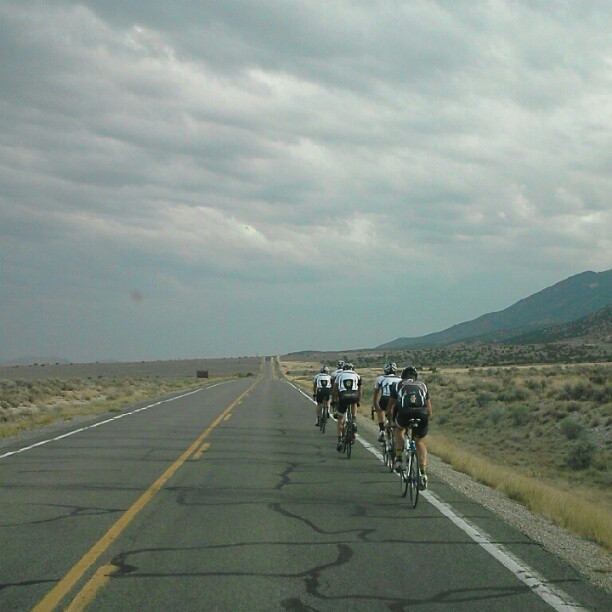
We started about 25 miles into Stage 4.  Because it was a 134 mile stage, and it had a “lollipop” in it, we had to push forward to get as far into the stage as we could before getting held up by the pros coming through.  Our start point was in the middle of the Utah desert.  Seriously… it was the desert.  The stage profile was very flat, so the riders made pretty good time.  Unfortunately, because it was the desert, there was very little scenery.  I did snap a few shots of the flat landscape and some Pony Express landmarks, though.

We did get caught by the pros on the lollipop, but we made it almost to the “end of the stick” before heading north, towards Salt Lake City.  It was a very long day, and I blame it mostly on the lack of scenery for the first several hours of the ride.  The week, so far, had been uneventful, as far as mechanical or rider support issues, which was good.

Stage 5 – Newpark Town Center to Snowbird (101.1 miles)

This stage was the queen stage of the Tour of Utah, with around 10,000 feet of climbing.  There were some serious climbs ahead of the guys, but we were more concerned about the start of the ride.  We were scheduled to have a ceremonial start at Newpark Town Center in the midst of a gran fondo that rode the entire race course.  Instead of the “ceremonial start” we were supposed to get, we ended up getting thrown in amongst the fondo riders.  In case you weren’t aware of it, support for an event like ours gets a lot harder when you add an extra 700 RIDERS to the road…

The extra riders added to the confusion, for sure.  At our first rest stop, I tried to speed up to get going and beat a group of fondo riders back onto the road, and forgot to shut the tailgate of the truck.  Looking in the rear-view mirror, I saw my big cooler come out of the truck and go spinning into the highway, rocketing bottles all over the place…  I cleaned up the mess, drove to a grocery store to replenish my ice and water, and continued on.  Everything was good in the end, but for about 45 minutes, I was pretty panic-stricken.

As we continued on, I had to fight my way through the fondo traffic up and down the intermediate KOM climbs to keep up with my group.  The climbs were tight and twisty, and it was very difficult with two-way bike traffic and auto traffic.  We managed to make it through the KOM’s, through the small towns where sprints were located, then approached the climb to Snowbird.  I had visited Snowbird before for a Specialized dealer event, about 3 years ago, so I knew the climb up to the resort.  It was a long, somewhat steep climb, and coming at the end of a 100-mile day, it was going to be no easy feat for our guys.

I made the decision to give the guys bottle hand-ups from the roadside on the way up the hill.  They would ditch their empty bottles, I’d give them a fresh bottle, then I’d give them a spray of water on their back or head and give them a push up the road.  This made a huge difference to them.  They were able to shed a bottle, get a little reprieve from the heat, and get a friendly boost up the road.  Helped for a second, at least…

All the guys made it up the climb, except one coach, Colin Izzard.  He had the legs to go up the climb, but one of the riders suffered a broken spoke, so he sacrificed his rear wheel and helped me sag the guys up the hill.  I definitely needed the help that day.  It was hot, and we did a lot of work on that last climb, making sure all the guys were okay.

Stage 6 – Park City to Park City (77 miles)

This was the final day of the Tour of Utah, and had some of the steepest climbing I had ever seen.  The ride was pretty chill for a long while, except for scrambling around for some odd course markings on some smaller, sketchier roads.  A lot of times, we headed out earlier than the course marking crews, so sometimes we miss turns if the numbers in the race bible get jumbled.  We had two or three odd turns that weren’t marked well, so we had to figure that out before moving forward.  Once we got back on the main road, we found our way.

There were a few major climbs in this stage.  The first was through a gated neighborhood, Wolf Creek Ranch, usually closed to the public.  Once we turned on the climb, we one of the steepest pitches I had ever seen.  After 5 days of riding, I know the guys were begging for it to stop, but the climbing continued…  The boys started “paperboy-ing” (weaving side to side to take the edge off the climb), so I got out of the truck to give them little pushes through some of the turns.  Unfortunately, this was only the first major climb of the day…

The guys continued on, rolling comfortably until we approached Empire Pass.  Empire Pass was hand-selected by Levi Leipheimer for this race, due to it’s length and difficulty, and probably because Levi knew the climb inside and out (Levi won Stage 6 on this day, after our athletes finished).  Needless to say, this climb was a huge obstacle for the athletes, regardless of their fitness.  Less than 500 meters into the climb, the “paperboy-ing” started again…  I knew we were in for it.

Strangely, one of our athletes, Shannon Lawrence from Bermuda, started stretching his legs a bit.  He was very nervous going into the day, and said for the first 40 miles of the ride that his legs were feeling very heavy.  On Empire Pass, he had evidently worked all the kinks out, because he steadily motored away from the rest of the group.  I don’t know what got into him, but he changed from flatlander to climbing machine that day.  It made things a bit difficult for me, though… he was so far up the road, I would have to zoom ahead in the truck to take care of him, then wait or drive back down the mountain to feed and push the other riders.  It was definitely a test of my abilities, not as a mechanic, but as a sag driver (NOTE:  My legs were sore the next day from running and pushing riders up 20% grade hills for two days… just sayin’…).

Shannon made it to the top first, and the rest of the group followed shortly thereafter.  There was a nice, long, windy descent with one minor little kick in it before the finish in Park City.  All the group descended into town together and finished the CTS Tour of Utah Race Experience together.  All the guys made it, and like most of the CTS events I’ve been to, they seem to have forged a bond and developed a sense of team accomplishment that I have only seen in my days in the Marines.  All the guys are friends, and seem to have gained a brotherly bond over the course of the week.

After we returned back down to Salt Lake City, I began packing bikes for the riders’ journeys home.  Once completed, we organized the trucks to travel to their respective destinations, then got ready for our team dinner and departure.  Another race week in the books.  Next up, four days off, then back out west for the Tour of Colorado… STAY TUNED!

Tour of Utah Recap – Stages 1-3

My week at the Tour of Utah with Carmichael Training Systems was amazing, as expected.  We had four athletes and three coaches, so the workload was okay for just one mechanic (me) and one soigneur (Colleen).   Here’s a quick little day by day rundown of what happened:

Pre-Race Organization Day

The day before the start of the race, all the athletes and staff arrived, and we hit the ground running.  As the athletes each arrived from the airport, they brought their bikes to me in the hotel parking lot, where all the teams were set up.  I found a great spot next to some mechanic friends that work for Optum/KBS and got comfortable.  My workspace consisted of a folding table, my toolbox, a box of ProGold lubricants and supplies that we were given (Thanks, Bruce!), my Feedback Sports Pro-Elite repair stand, two a-frame bike racks, and a CTS E-Z Up tent.  That was really all I needed to get bikes built.  Later in the week, I would need water hookups to wash down the bikes and such, but for initial building and preparation, it wasn’t necessary.

After all the prep work was done for the first stage, we had a rider/staff meeting to introduce each other, discuss the details of the camp, and plan out the next day’s schedule.  It’s important to keep meetings like that kind of chill and to try and get to know the athletes a little better.  Developing trust with them is key.  They need to trust me to work on their bikes and support them throughout the week.  I try to learn the athletes’ little habits and nuances early in the game, so I can address them before a situation arises on the road.  By doing that, we can eliminate a lot of panic-stricken situations in the future.

Stage 1 – Ogden to Ogden (131.7 miles)

The logistics of this first day were kind of weird.  In order for us not to get caught by the pros, we had to cut off a little “lollipop” section of course near Henefer, UT.  We started out strong for about 200m… then the day’s first flat tire.  Because we hastily prepared and had supplies and staff coming from several different locations, we forgot to pack any spare wheels.  After installing a new tire and tube, the new tube was pinched by the tight bead of the tire.  Flat tire number two.  After changing that, we were on our way.

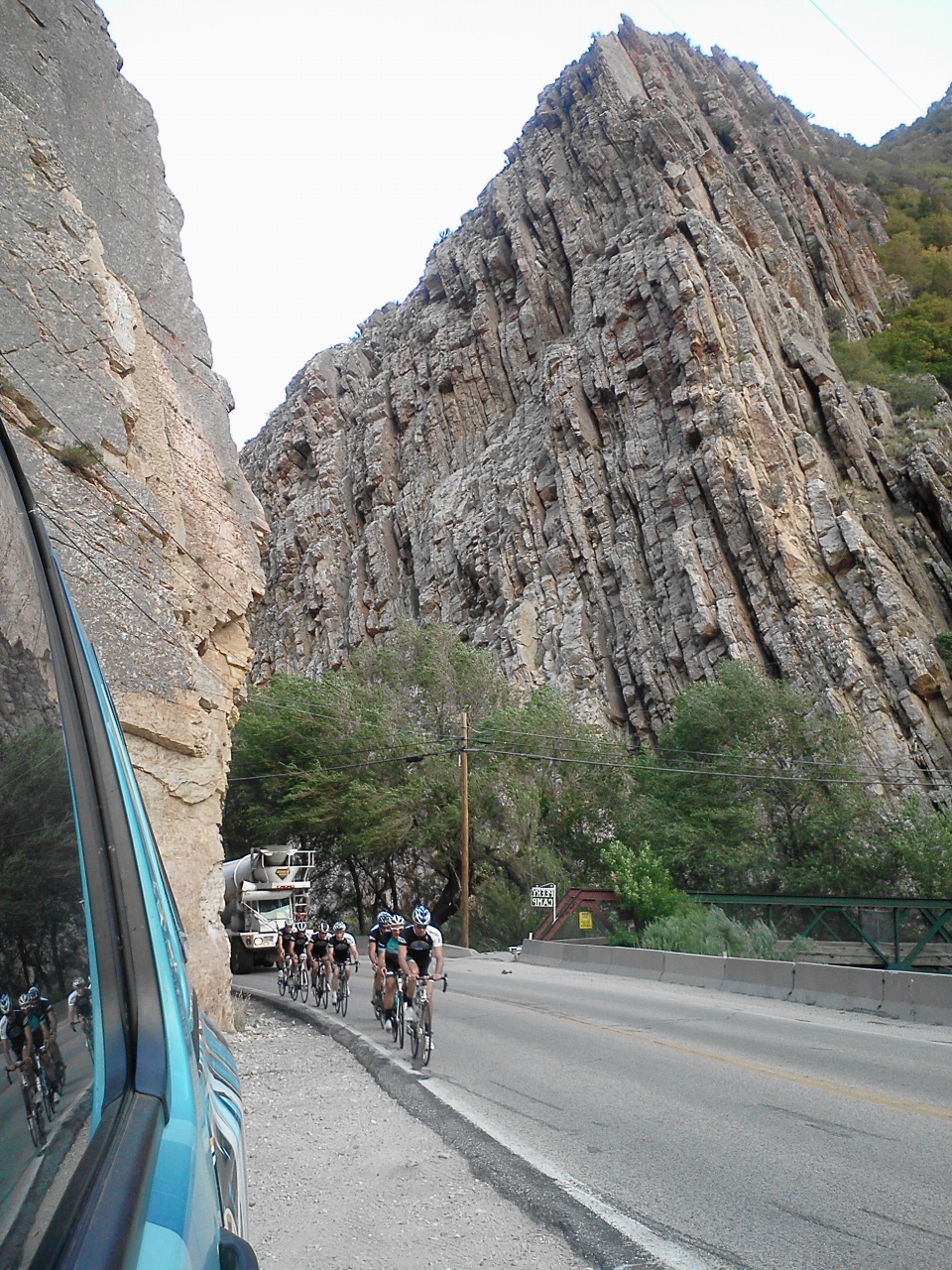
Less than 30 minutes later, as the riders were ascending through a tight canyon, just north of Ogden, we had a third flat on the road.  One rider picked up a piece of debris in a tire, causing him to develop a somewhat slow leak.  The object was removed from the tire, a new tube installed, and we were back on the road… again.  Luckily, this would be the last flat for quite some time.  We continued out of the canyon, and kept pedaling down the road.

After several rest stops and our turn around point on Hwy 65, we returned towards Ogden.  We had to stop near Interstate 84 and wait a few minutes because the pro race was coming through.  It gave us a good time to refuel, and the first chance for the CTS athletes to see the actual race in progress.  Afterwards, we continued back up towards Ogden, making a rest stop in Eden.  At the Eden rest stop, CTS coach Kirk Nordgren’s cousin was waiting with her kids and had homemade signs to cheer him on!  That was a really cool experience, primarily because it was in the middle of nowhere, and they were just hanging out waiting for us.

After the last KOM of the day, North Ogden Divide, CTS coach Colin Izzard’s carbon clincher wheels came apart on the descent.  He had been feeling pulsating during braking all day, but we couldn’t feel anything structurally upon inspection.  Less than 500m into the descent, he comes on the radio and said his wheels were toast.  Both his tires had punctured, and both his rims were victims of overheating and delamination.  Not cool.  He was very lucky to be able to control the bike without crashing, or worse.  Definitely a situation where spare wheels would have been nice to have.  We loaded he and his bike in the CTS truck and continued down the hill to finish with the group.

I had a bit of parts-switching to do after Stage 1.  Kirk (camp manager), offered his wheels to Colin (lead coach), so he could continue to ride with the CTS athletes.  Going from carbon rims to aluminum rims, this meant switching brake pads, wheels, and ensuring the gearing was proper for the rest of the week’s climbs.  After switching around the parts, the bikes were washed and tuned, before stowing them in my hotel room (because of lack of a team trailer at this event – the CTS trailer was at Leadville, CO, supporting the riders at the Leadville Trail 100).

Stage 2 – Miller Motorsports Park – Team Time Trial (13.5 miles, 3 laps)

We transferred from our hotel in Ogden, south of Salt Lake City to Miller Motorsports Park, near Tooele, UT.  The CTS athletes were getting the opportunity to get on course before the pros for the Team Time Trial stage of the Tour of Utah, which meant they were going to be riding their bikes on the world-class track, normally used for motorcycle and auto racing.  We were able to set up our pit area inside one of the garages at the facility, just like the pro teams did.  The guys took three laps on the track; one to warm up and get used to the track, a second “hot” lap, where they utilized time trial tactics, and after a quick clinic on the team time trial, a third cool-down lap.  The guys were stoked to be able to get on the course, and I was stoked to be able to follow them in the support vehicle.  I’m not going to lie… it was pretty rad to drive the truck on the track, even if I wasn’t pushing it as hard as I would have liked…

I left the track a little earlier than the athletes, so I could get back to the hotel and get the bikes ready for the next day’s stage.  The guys only did 13.5 miles on the day, so they didn’t need as much attention as they did after a 100-mile day.  I wiped them down with some ProGold ProTowels, checked them over, and put the bikes away for the evening.

Stage 3 – Ogden to Salt Lake City – 85.5 miles

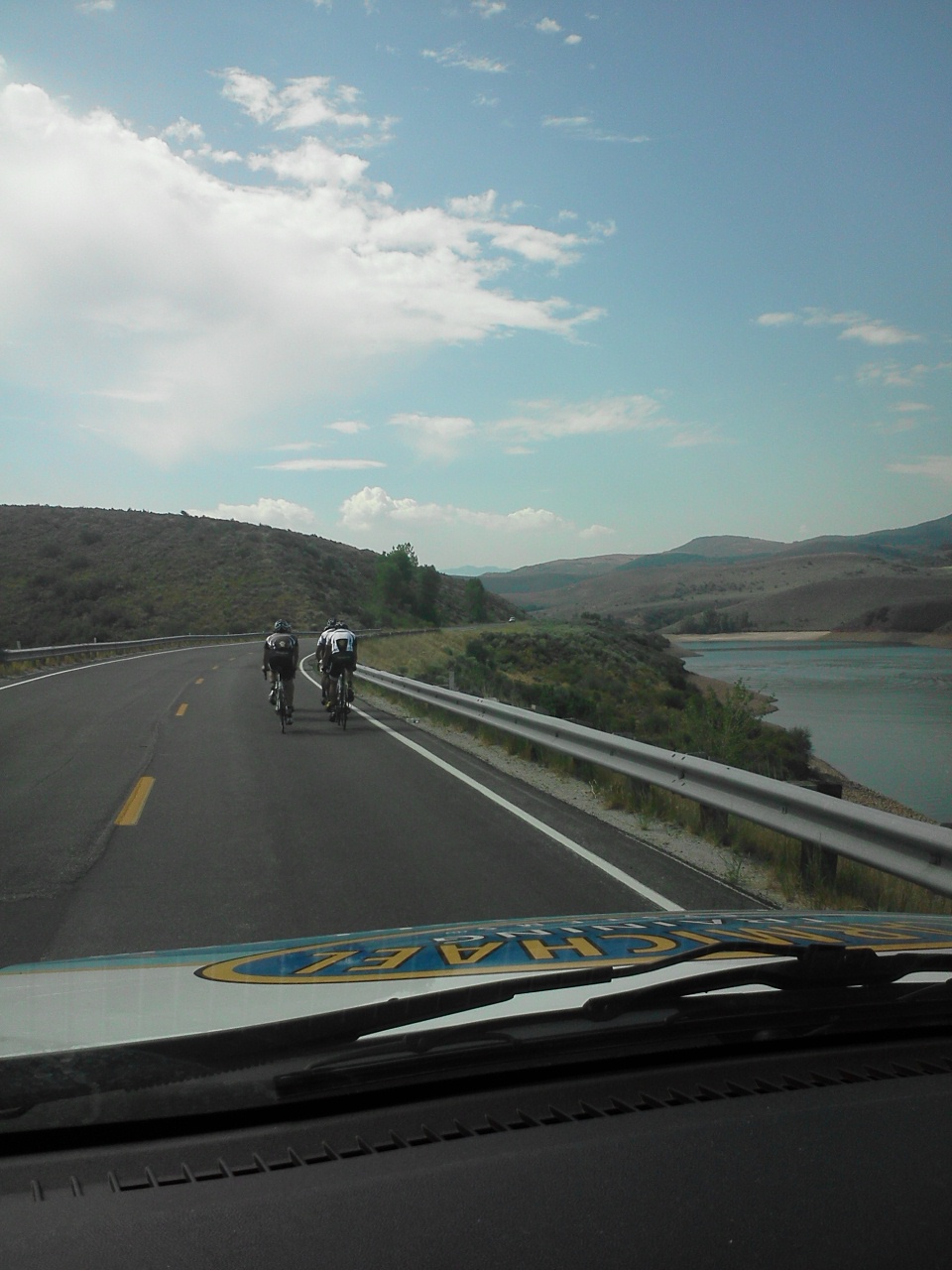
Stage 3 was very interesting.  The Tour of Utah’s route utilized a lot of the same roads on this stage as it used on Stage 1, just backwards.  The first climb of the day was heading the opposite direction over North Ogden Divide, then ran the route backwards, to Snowbasin for the third time this tour.  Following that, we descended down to Morgan, UT, and around a reservoir to Hwy 65, and up over a mean little climb called Big Mountain.  It was a pretty big challenge for the guys, and there was some separation in the group, but the view at the top and the descent into Salt Lake City was amazing.  The CTS athletes continued to surprise me, and did a great job staying together.  It made it pretty easy to support them from the vehicle, and take care of them when they needed assistance because of their cohesion as a group.

Except for Stage 1, there were no real mechanicals, flats, or any real issues up to this point, which made me feel pretty confident in the work I was putting into the bikes.  Usually, the third day is when everything starts to get ironed out, as far as systems go.  I was starting to nail down my organization of the support vehicle, seeing how things were working for me on a couple of road race stages, and figuring out the group’s dynamic.  After a few days on the road, you get used to their patterns of natural breaks and rest stops, and beat them to the punch. The key is to be one step ahead of the game, unless you can’t be… then you just remain flexible.

I’ll write more about stages 4-6 tomorrow.